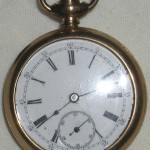
On November 30, 1864, the Carter House was at the epicenter of one of most horrific battles of the Civil War. This clock belonged to the eldest son of the family, Lt. Colonel Moscow Branch Carter. Moscow Branch, who had been taken prisoner earlier in the war, was home on parole at the time of the battle. This clock was in his downstairs room.
A overall before shot. The Ogee style case is in good condition, though some veneer is missing or loose.
A tighter shot of the dial and tablet.
Detail of the dial. There is a single ring outside the dot minute markers on an embossed zinc plate. There is no tapering of any numerals and the winding holes are about 9.8mm to 10mm in diameter. All this places the date of the dial to be probably 1852.
The bottom part of the label which would have the printers name is gone. This would have helped us narrow the date of the case. However, the label clearly states “Thomaston” as the city of manufacture. This means that the case was made no earlier than 1865. This clock is looking like a “marriage”. Seth Thomas made Ogee style tall case clocks as late as 1913. However, I doubt that the case is anywhere near that late.
Here you can easily read “Thomaston”. The wire supporting the movement bracket is a post-manufacture enhancement. Perhaps the original case was shot apart during the battle.
First shot of the movement before cleaning.
Strike and time weights.
“PLYMOUTH, CONN” stamped on the movements means it was manufactured before 1865. I am going the guess that the movement is the same age as the dial.
First shot of the movement out of the case. No obvious damage or bad wear. Finish nails in place of tapered pins holding the front plate on.
Way too much nylon twist cord tangled on the time-side arbor.
A bit of rust on the posts. Some navel jelly will bring that under control.
A tangle of nylon on the strike-side winding arbor.
Back plate. No surprises.
Looking between the plates on the strike side.
The movement is mounted to its base using round, not square, threaded nuts.
Detail of time side.
Details of escapement wheel.
Details under the movement after removing the base.
Front plate removed.
Time side center wheel in the foreground.
Top end of movement
Strike side center wheel.
Back side of top place. The count wheel is still attached.
Bottom end view of movement.
First picture of cleaned parts. This is the time side first wheel disassembled.
Lot of cleaned movement parts in a basket.
First picture of the cleaned movement reassembled. Taped pins used instead of finish nails. I will trim the pointed ends a little later.
A cleaned view of the front plate.
Replacing twisted white nylon with a braided nylon. The braid is stained using a black dye to make it less noticeable.
The pallets had pits from years of contact with the escapement wheel. These were sanded out, polished, tempered, and then polished again. Now you can see the reflection of a pencil in the pallet.
The pallets had pits from years of contact with the escapement wheel. These were sanded out, polished, tempered, and then polished again. Now you can see the reflection of a pencil in the pallet.